




Now Reading: Genesis 10 NIV
- 01
Genesis 10 NIV


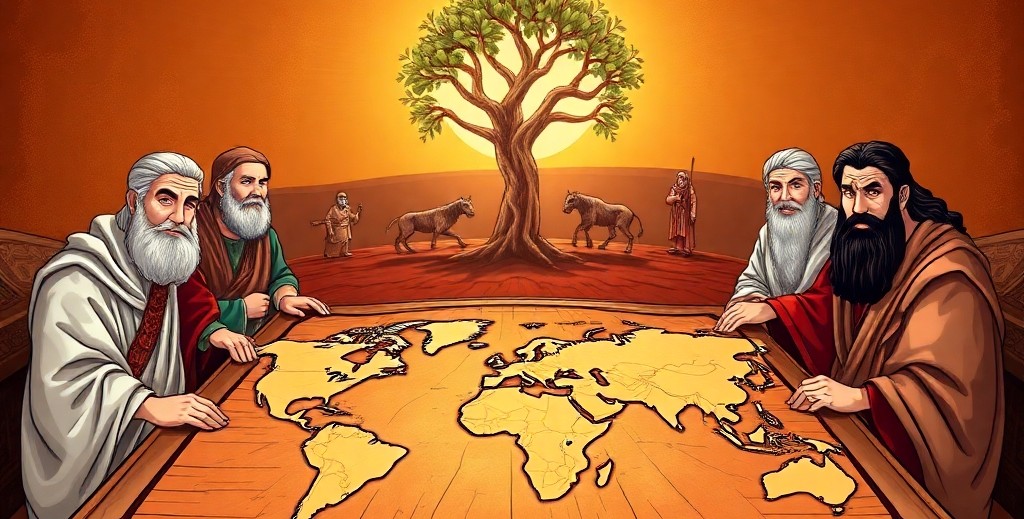





The Table of Nations
1This is the account of Shem, Ham and Japheth, Noah’s sons, who themselves had sons after the flood.
The Japhethites
2The sons a of Japheth: Gomer, Magog, Madai, Javan, Tubal, Meshek and Tiras.
3The sons of Gomer: Ashkenaz, Riphath and Togarmah.
4The sons of Javan: Elishah, Tarshish, the Kittites and the Rodanites. b 5(From these the maritime peoples spread out into their territories by their clans within their nations, each with its own language.)
The Hamites
6The sons of Ham: Cush, Egypt, Put and Canaan.
7The sons of Cush: Seba, Havilah, Sabtah, Raamah and Sabteka.
The sons of Raamah: Sheba and Dedan.
8Cush was the father c of Nimrod, who became a mighty warrior on the earth. 9He was a mighty hunter before the Lord; that is why it is said, “Like Nimrod, a mighty hunter before the Lord.” 10The first centers of his kingdom were Babylon, Uruk, Akkad and Kalneh, in d Shinar. e 11From that land he went to Assyria, where he built Nineveh, Rehoboth Ir, f Calah 12and Resen, which is between Nineveh and Calah—which is the great city.
13Egypt was the father of the Ludites, Anamites, Lehabites, Naphtuhites, 14Pathrusites, Kasluhites (from whom the Philistines came) and Caphtorites.
15Canaan was the father of Sidon his firstborn, g and of the Hittites, 16Jebusites, Amorites, Girgashites, 17Hivites, Arkites, Sinites, 18Arvadites, Zemarites and Hamathites. Later the Canaanite clans scattered 19and the borders of Canaan reached from Sidon toward Gerar as far as Gaza, and then toward Sodom, Gomorrah, Admah and Zeboyim, as far as Lasha.
20These are the sons of Ham by their clans and languages, in their territories and nations.
The Semites
21Sons were also born to Shem, whose older brother was h Japheth; Shem was the ancestor of all the sons of Eber.
22The sons of Shem: Elam, Ashur, Arphaxad, Lud and Aram.
23The sons of Aram: Uz, Hul, Gether and Meshek. i
24Arphaxad was the father of j Shelah, and Shelah the father of Eber.
25Two sons were born to Eber: One was named Peleg, k because in his time the earth was divided; his brother was named Joktan.
26Joktan was the father of Almodad, Sheleph, Hazarmaveth, Jerah, 27Hadoram, Uzal, Diklah, 28Obal, Abimael, Sheba, 29Ophir, Havilah and Jobab. All these were sons of Joktan.
30The region where they lived stretched from Mesha toward Sephar, in the eastern hill country.
31These are the sons of Shem by their clans and languages, in their territories and nations.
32These are the clans of Noah’s sons, according to their lines of descent, within their nations. From these the nations spread out over the earth after the flood.
Footnotes:
a2Sons may mean descendants or successors or nations; also in verses 3, 4, 6, 7, 20-23, 29 and 31.
b4 Some manuscripts of the Masoretic Text and Samaritan Pentateuch (see also Septuagint and 1 Chron. 1:7); most manuscripts of the Masoretic Text Dodanites
c8Father may mean ancestor or predecessor or founder; also in verses 13, 15, 24 and 26.
d10 Or Uruk and Akkad—all of them in
e10 That is, Babylonia
f11 Or Nineveh with its city squares
g15 Or of the Sidonians, the foremost
h21 Or Shem, the older brother of
i23 See Septuagint and 1 Chron. 1:17; Hebrew Mash.
j24 Hebrew; Septuagint father of Cainan, and Cainan was the father of
k25Peleg means division.